Author Archives: Bally Ribbon Mills

  1. Bally Ribbon Mills to Display High Performance 3-D Woven Composites at CAMX 2023

    Comments Off on Bally Ribbon Mills to Display High Performance 3-D Woven Composites at CAMX 2023

    CAMX banner

    Bally Ribbon Mills (BRM) announces that it will showcase its high-quality, high-performance products at CAMX 2023, taking place October 30-November 2, 2023 in Atlanta, Georgia. BRM experts will be on hand in booth K46 to discuss the company’s 3-D woven joints, thermal protection systems (TPS), and other 3-D structures.

    In partnership with NASA, BRM recently developed the 3D Orthogonally woven 3DMAT Quartz Material for the Orion Multi-Purpose Crew Vehicle (MPCV) compression pads. BRM and NASA efforts are a great example of NASA partnering with an American small business with a unique specialized technological capability that will further current and future exploration plans. The 3DMAT Quartz Material was recently named the 2023 NASA Government Invention of the Year.

    BRM uses 3-D continuous weaving to create new joint structures and improve existing joints. Delivering the optimal blend of strength, durability, and structural integrity, BRM’s 3-D woven joints are available in “Pi – π,” double “T,” “H,” and other complex net shapes. 3-D woven joints from BRM lower weight and cost without sacrificing integrity and performance. Because of the nature of the 3-D weave, strength and support is translated in all 3 dimensions, thus enabling the join to reinforce the strength along the load paths of the sub-structures being joined together. These 3-D woven shapes for joining can be tailored to suit the architecture of the structure itself, as well as the sub-components being joined.

    3-D woven composites by BRM are particularly successful in aviation heat shield applications such as thermal protection systems. These systems are mission-critical components, particularly in space exploration vehicles, and 3-D woven composites reduce weight and cost while maintaining excellent performance in TPS systems. The ability to vary yarn types, density, thickness, and width, as well as resin type, allows BRM to create fully customizable TPS to fit each specific mission or application’s needs.

    Along with TPS systems, 3-D woven components also function well as engine parts in aircraft. Replacing traditional titanium engine components with 3-D woven carbon fiber composites serves to reduce weight and therefore lifetime cost, all while meeting the rigorous demands of manufacturing and use.

    For more information, speak with BRM experts in booth K46 (Building C, Level 1) at CAMX 2023.

  2. Bally Ribbon Mills to Showcase High-Performance Webbing at the 2023 Advanced Textile Expo

    Comments Off on Bally Ribbon Mills to Showcase High-Performance Webbing at the 2023 Advanced Textile Expo

    Bally Ribbon Mills Orion

    Bally Ribbon Mills (BRM) announces that it will showcase new high-quality, high-performance webbing designs at the Advanced Textiles Expo 2023 taking place November 1-3, 2023. Meet with BRM experts to discuss the company’s award-winning materials, tapes, webbings and specialty textiles, including high-performance webbings, e-webbings and other narrow fabrics at booth E308.

    In partnership with NASA, BRM recently developed the 3D Orthogonally woven 3DMAT Quartz Material for the Orion Multi-Purpose Crew Vehicle (MPCV) compression pads. BRM and NASA efforts are a great example of NASA partnering with an American small business with a unique specialized technological capability that will further current and future exploration plans. The 3DMAT Quartz Material was recently named the 2023 NASA Government Invention of the Year.

    BRM’s new fabrics utilize custom weave designs and high-performance fibers or combinations of fibers. BRM has created these patterns specific to end-use applications and can customize  innovative patterns for new applications. Come see materials in the following categories:

    • E-WEBBINGS® – woven fabrics of traditional fibers in conjunction with “functional” elements: conductivity, light transmission, and sensors.
    • Composites – fabrics that contain more than one unique fiber for the purpose of utilizing different and inherent properties of each component fiber.
    • Tapes and Webbing with Superior Properties – high strength to weight ratio, chemical resistance, low elongation, and many more.
    • Materials on Planet Mars – engineered fibers and fabrics utilized by NASA, ESA, and commercial near and deep space contractors for mission success and to keep our astronauts and pilots safe.

    For a century, Advanced Textiles Expo has been the industrial fabrics industry’s flagship show. As the premier textiles event, Expo is the place where industry stakeholders and leaders connect, learn, and make purchases in order to grow their businesses.

    For more information, connect with experts at BRM booth E308 at Advanced Textiles Expo or visit https://www.ballyribbon.com/.

  3. Bally Ribbon Mills Features Highly Specialized Engineered Woven Fabrics at SAFE Association Symposium

    Comments Off on Bally Ribbon Mills Features Highly Specialized Engineered Woven Fabrics at SAFE Association Symposium

    SAFE Symposium BRM 2023

    Bally Ribbon Mills (BRM) announces it will highlight its creative solutions for product design and development at the SAFE Association 61st Annual Symposium, which will be held October 10-12 at the Virginia Beach Convention Center, Virginia Beach, VA, Booth #132. On display will be a selection of the company’s high-performance webbings, including safety webbings and tapes, ideal for military, aerospace, fire, law enforcement, industrial, and commercial fall protection personal protective equipment (PPE) as well as specialty items to showcase BRM’s capabilities.

    Using its decades of weaving expertise, BRM designs, engineers, and manufactures materials that maximize the end products’ performance characteristics and properties – including strength, durability, resistance to abrasion, chemicals, heat and weather. BRM enjoys the challenge of assisting customers in problem resolution and innovation creation regarding material selection in their design and development phases. BRM’s services include development of customized innovations, complete engineering and solutions, sample preparation, and full-scale and specialty manufacturing.

    Recently, BRM participated in an exciting project with Sierra Space in which embedded fiber optic sensors were woven into Vectran ® webbing and then later integrated into an inflatable test article that was tested at NASA Johnson Space Center for potential use in future inflatable habitat structures for NASA Lunar Gateway and Mars missions.

    Experts will be on hand at booth #132 to show how BRM can design, develop and manufacture specialized, engineered, woven safety webbings and tapes. Made from Nylon, Polyester, Nomex®, Kevlar®, Vectran®, PBI®, Nextel®, and other specialty fibers, BRM’s safety webbing and tapes are ideal for applications requiring high tenacity, abrasion resistance and flame and heat resistance. They are also a good choice for controlled elongation applications as well as those requiring chemical resistance in specific environments, and can be used for shoulder straps, harness webbing, and chin straps, as well as helmet suspension, binding tapes, loop tapes, lap belts, shock absorbing webbing, flotation device webbings, parachute assemblies, and other aerospace safety applications.

  4. Bally Ribbon Mills Supplies E-WEBBINGS® E-textiles to Best Aviation Services, Inc. for Torabhaig Atlantic Explorer Gas Balloon

    Comments Off on Bally Ribbon Mills Supplies E-WEBBINGS® E-textiles to Best Aviation Services, Inc. for Torabhaig Atlantic Explorer Gas Balloon

    Best Aviation Services

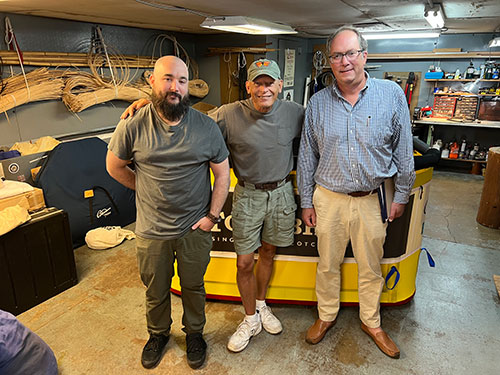
    Bally Ribbon Mills (BRM) announces it provided E-WEBBINGS® e-textiles to Best Aviation Services. Inc., the balloon manufacturing and repair company supplying a tension system to support the Torabhaig Atlantic Explorer gas balloon’s open basket as it takes the first flight across the Atlantic in an open basket gas balloon. The innovative design incorporates electronic components used to dissipate static electricity. The balloon will take off from Maine and then fly over Newfoundland before crossing the Atlantic and landing in Europe.

    The new design was critical to meeting the very tight manufacturing timeline by reducing the project’s Bill of Materials and saving Best Aviation hundreds of hours of additional sewing. Bert Padelt, owner of the Bally, Pennsylvania-based balloon manufacturing and repair company, said, “Because of your design and quick turn-around on this R&D work, we were able to meet our tight deadline and launch window schedule.”

    Torabhaig Atlantic Explorer gas balloon open basket

    The Torabhaig Atlantic Explorer, piloted by UK-based Sir David Hempleman-Adams, will collect air samples to look for new scientific discoveries. Sir Hempleman-Adams will be accompanied by Bert Padelt and Swiss explorer, scientist and entrepreneur, Dr Frederik Paulsen. The journey is expected to take four to five days, flying at an altitude of 6,000 to 8,000 feet. It would be the first Atlantic crossing in a hydrogen balloon and may also mark the longest distance covered in this type of balloon.

    For more information on the Torabhaig Atlantic Explorer visit this link and this link.

  5. 3D Orthogonally Woven 3DMAT Quartz Materials Named NASA Government Invention of the Year

    Comments Off on 3D Orthogonally Woven 3DMAT Quartz Materials Named NASA Government Invention of the Year

    Bally Ribbon Mills Orion

    Bally Ribbon Mills (BRM) announces the 3D Orthogonally woven 3DMAT Quartz Material for the Orion Multi-Purpose Crew Vehicle (MPCV) compression pads, developed through their partnership with NASA, has been named the 2023 NASA Government Invention of the Year. The award demonstrates NASA Ames Research Center’s commitment to cutting edge leadership and technology development for the nation. BRM and NASA efforts are a great example of NASA partnering with an American small business with a unique specialized technological capability that will further current and future exploration plans.

    Compression pads serve as the interface between the crew module and service module of the Orion MPCV and carry the structural loads generated during launch, space operation, pyroshock separation of the two modules. The compression pads also serve as ablative TPS withstanding the high heating of earth reentry. 3DMAT leverages NASA’s investment in woven materials for the Orion compression pads that combines the weaving of quartz yarns with resin transfer molding.

    The 3DMAT technology has helped BRM introduce 3D orthogonal woven materials to a range of new applications. Learn more about the award winning 3DMAT material here.

  6. Bally Ribbon Mills to Highlight Custom Designed Tapes and Webbings at Techtextil North America 2023

    Comments Off on Bally Ribbon Mills to Highlight Custom Designed Tapes and Webbings at Techtextil North America 2023

    Bally Ribbon Mills at Textil America

    Visit Booth #2103 as BRM celebrates its 100th Anniversary

    Bally Ribbon Mills (BRM) announces its participation and celebration of its 100th Anniversary at Techtextil North America, which will be held May 10-12, 2023 at the Georgia World Congress Center, Atlanta, GA. Visit BRM at booth 2103 to see its standard and custom designed tapes and webbings for a wide range of applications.

    Since BRM’s founding in 1923 as a custom textile manufacturer in Bally, PA, the company has provided products for aerospace, defense, medical, safety, automotive, commercial, and industrial applications used around the world.

    In booth 2103, see BRM’s range of products:

    • E-WEBBINGS® – woven fabrics of traditional fibers combined with “functional” elements: conductivity, light transmission, and sensors.
    • Composites – fabrics that contain more than one unique fiber for the purpose of utilizing different but inherent properties of each component fiber.
    • Tapes and Webbing with Superior Properties – high strength to weight ratio, , abrasion resistance, low elongation, and many more critical design characteristics.
    • Materials on Mars – engineered fibers and fabrics utilized by NASA, ESA, and commercial contractors for mission success in applications for near and deep space applications.

    Techtextil North America is the largest showcase of trendsetting technical textiles and nonwoven products in the Americas. The show assembles all vertical aspects of the technical textile industry: from research and development, through raw materials and production processes and finally ending in conversion, further treatment, and recycling.

    For more information on Bally Ribbon Mills highly specialized engineered woven fabrics visit www.ballyribbon.com.

  7. Bally Ribbon Mills Celebrates a Century of Textile Innovation

    Comments Off on Bally Ribbon Mills Celebrates a Century of Textile Innovation

    Bally Ribbon Mills 100th Anniversary 2023

    Bally Ribbon Mills (BRM)is proud to announce a century of textile innovation with its 100 Year Anniversary. Since BRM’s founding in 1923 as a custom textile manufacturer in Bally, PA, the company has provided products for aerospace, defense, medical, safety, automotive, commercial, and industrial applications used around the world.

    A small representation of BRM’s accomplishments over the past century include the production of goods for the war effort in World War 2, maintaining a continuous ISO quality program for close to 30 years, and numerous contracts, including with the U.S. Military, Department of Defense and NASA. BRM’s work with NASA includes using composite material in the construction of the heat shield used on NASA’s Orion spacecraft. BRM has been praised by NASA for its ability to answer every specification and challenge.

    “As a family business, Bally Ribbon Mills is extremely proud to be a trusted partner by some of the largest, well-known companies and agencies from around the world,” said Mark Harries, Vice President, at Bally Ribbon Mills. “Our success has been based on a long-term vision of growth, built around our high-quality engineered fabrics manufactured in America, our skilled employees, and our reputation as a trusted advisor to customers. We will continue to stay at the forefront of technology for all of the industries we serve, just as we have over the past 100 years.”

    BRM continues to expand and innovate at its Bally, PA facility through the addition of new equipment, departments, and employees.

  8. Designing with E-WEBBINGS® e-Textiles

    Comments Off on Designing with E-WEBBINGS® e-Textiles

    As electronics continue to shrink, becoming simultaneously more compact and powerful, they’re being used in an increasingly diverse range of products and devices.

    In people’s everyday lives, this is most apparent in the Internet of Things (IoT) — the interconnection of devices and products via the internet that allow them to “communicate” with each other through the sending and receiving of data. Home appliances, thermostats, light bulbs, remotes, home security systems, and even clothing can now all be embedded with electronics and software allowing them to collect and exchange data. In hospitals, for example, “smart textiles” in clothing may be used to monitor patients’ vital signs.
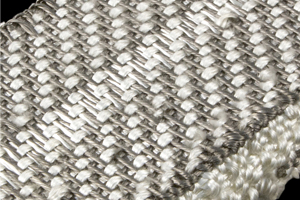
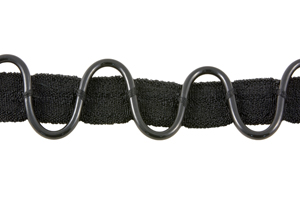
    To meet manufacturers and consumers’ shifting needs, Bally Ribbon Mills (BRM) is proud to offer our proprietary E-WEBBINGS®, an e-textile product base created by combining non-conductive fibers and specialized conductive elements. These products serve as the foundation layer to which electronic intercommunicative technology is integrated directly. E-WEBBINGS® are specifically designed to serve as a customizable base for a wide range of smart textile applications within the IoT.

    Allowing for smaller final product size, lower weight, optimal user comfort, and significant cost savings, these smart textiles offer a range of benefits. But how do E-WEBBINGS® work, and how are they designed?

    Download E-WEBBINGS®: Narrow Woven Fabrics for the IoT Technology Sector

    E-WEBBINGS® Design, Components, and Purposes

    Before beginning work on designing and customizing E-WEBBINGS®, our engineers take the time to thoroughly understand the purpose and specific requirements of the end device, and we work closely with our clients throughout each step of the process to ensure all needs are met.

    Every component and factor that goes into an E-WEBBINGS® textile is thoughtfully and carefully chosen, since each piece needs to work together seamlessly — the conductor, the base webbing, the power source, and the sensor. Often, choosing to work with one type of component necessitates the use of another. For example, if a sensor requires a robust power source, a larger wire may need to be used as the conductor. And, in this case, the webbing would then need to be thick enough to reliably protect and carry the wire.

    Conductors

    Conductive fibers or wires can be woven into the E-WEBBINGS® fabric itself. This allows for the transmission of power and information, without the need for additional wiring in the final component. This also helps cut down on the manufacturer’s bill of materials and allows for a simplified, streamlined end product. Various options are available for conductor type; the best fit will depend on the type of sensor used or specific power requirements.

    Sensors

    Options are virtually limitless for the number and types of sensors used, but decisions are typically made depending on where within the product the textile structure is located, and what types of information and data it needs to measure. Also, the natural properties of weaving can benefit certain sensors, depending on their size and shape, as certain weaves are better-suited to certain attachments and types of sewing.

    Learn More

    To learn more about E-WEBBINGS® from Bally Ribbon Mills or to discuss your next project with one of our experts, reach out to the team today.

  9. Understanding Your Custom Weaving Options

    Comments Off on Understanding Your Custom Weaving Options

    Weaving is a textile production method that uses a loom to interlace two sets of yarn at right angles. To create fabric, the lateral yarn, called the weft, repeatedly crosses with the longitudinal yarn, referred to as the warp, which is held taught by the loom.

    The process of weaving can be summarized in three steps:

    • Shedding — The warp ends are separated to clear a space for a pick
    • Picking — The pick inserts the weft through the shed
    • Beating — The reed pushes the weft up against the fell of the cloth completing one weave cycle

    Although the basic weaving process is the same, the specific method in which the yarn is interlaced and propelled through the shed can change the characteristics of the finished fabric. Popular methods of weaving include the use of:

    • Shuttle loom
    • Shuttleless loom
    • Jacquard loom

    Shuttle Loom

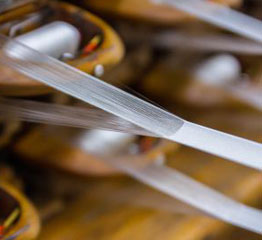
    shuttleloomweaveThis conventional loom type – which includes hand looms, non-automatic power looms, and automatic weaving machines – interlaces the weft and warp yarn using a shuttle (usually made of wood). This method can manufacture seamless fabrics and tubular materials, making it suitable for critical applications requiring uniformity. It is slower than shuttleless looms.
    Shuttleless Loom

    This is a loom type which includes needle looms, rapier looms, and water/air jet looms. Its highly efficient operation increases production capacities while reducing large run labor costs. Needle loom models produce material with one woven edge and one knitted edge.

    Jacquard Loom

    A jacquard loom is a mechanical loom that simplifies the manufacture of complex patterns. Originally controlled by a sequence of hole-punched cards laced together, these looms now operate under CAD systems. They can be labor-intensive to set up initially. Jacquard weaving is a durable, high quality alternative to printed webbing, capable of producing a variety of weaves, designs, and logos from a single warp.

    About Bally Ribbon Mills

    Bally Ribbon Mills (BRM) is capable of each of these weaving methods, as well as specialty broadcloth, utilized for R&D and special projects with the ability to weave up to 72” widths. In addition to our diverse offering of weaving technologies, BRM provides a host of secondary processes such as dyeing, finishing, strap cutting, hole punching, and sonic welding.

    For more information about weaving, download our free eBook, Shuttle Loom Weaving: Benefits for Critical Use.

    Shuttle Loom Weaving: Benefits for Critical Use

  10. Enhancing Our Capabilities to Meet NASA’s Needs

    Comments Off on Enhancing Our Capabilities to Meet NASA’s Needs

    At Bally Ribbon Mills (BRM), we design, develop, and manufacture high quality engineered webbing, tape, and narrow fabric. While our products’ applications vary across a range of industries, we focus particularly on the technology needed to manufacture specialized webbing for critical use applications.

    We are proud of the role our critical use products have played in the aerospace industry, as well as our trusted partnership with NASA on recent projects. Last year, NASA Administrator Charles Bolden visited our facility to support our work on a new space mission technology, declaring, “From this day on, the path to Mars goes through Bally, Pennsylvania.”

    In order to enhance our product capabilities to meet NASA’s needs, we have been implementing innovative weaving technologies using high strength fibers such as Kevlar®, Technora®, and Vectran® to develop complex webbing for aerospace products.

    adapt2These lightweight materials comprise 3-D woven fabrics and multifunctional thermal protection system (TPS) padding for NASA directed commercial sector space vehicles. Our TPS padding was selected as the critical component of the heat shield on the Orion Crew Capsule, which helps protect against the extreme temperatures of atmospheric re-entry during missions to the moon, asteroids, or Mars.

    We provide customers with robust complex materials optimized for the low pack volume and high energy absorption that critical use applications demand. Our advanced launch and recovery decelerator webbing has been key to the successful design of space rocket launch vehicles and capsule recovery programs. We also design T, X, and Pi shaped webbing for lighter-than-air inflatable airships, surveillance aerostats, and NASA directed commercial sector space vehicles (COTS).

    Our high performance webbing has appeared in a variety of other aerospace, space, and commercial applications such as parachutes, flight suits, seat belts, seat construction, cargo netting reinforcement tapes, and crew safety components. We ensure that all of our products pass strict Mil-Spec, PIA-Spec, and Department of Defense Berry Amendment requirements for the procurement of fabrics and textiles.

    BRM was proud to be featured as a Phase II Company in NASA’s ­highly competitive Small Business Innovation Research (SBIR) program for our four year support of the Orion project, as well as our current work for an upcoming EM-1 mission. We are grateful for NASA’s commitment to integrating small businesses into its contractor base, and we are dedicated to leveraging our unique strengths to help pioneer the future of space exploration.

    Want to Learn More?
    Since 1923, Bally Ribbon Mills has been a leader in the design, development, and manufacture of 2-D and 3-D specialty webbing. Our custom engineering and diverse weaving technologies enable us to provide advanced products for both commercial and critical use applications.

    To learn more about how 3-D woven composites outperform their metallic counterparts to support critical use applications, download our eBook The Benefits of 3-D Woven Composites.

    The Benefits of 3-D Woven Composites